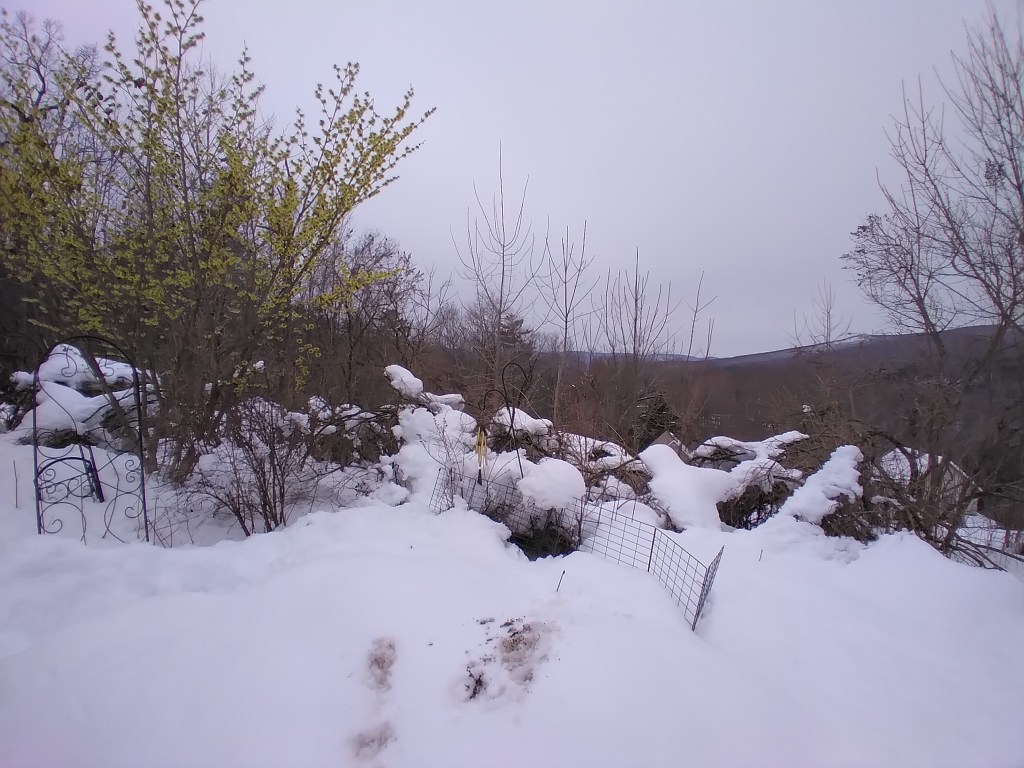
The one good thing about a late-winter blizzard in New England is that no matter how much snow Mother Nature dumps on our doorsteps, we know it’s going to melt in the not too distant future. And so it is with this year’s March madness that dumped two feet of snow at my doorstep and in the garden.
The sun came out, and places where the snow had been shoveled, like the driveway and stairs, suddenly reappeared as the last of their snow cover disappeared into mud puddles and runoff. Snow piles and snow-covered areas shrank, though they’re still pretty high and deep. And I watched anxiously as inch by inch the vanishing snow cover revealed what damage the heavy, wet snow had caused.
The winner of it all was the witch hazel, a small tree I planted over a decade ago. Its blossoms are always the first flower of the year, often coming into bloom in March while there’s still snow on the ground. This week’s blizzard covered the tree in heavy, wet snow that bent its branches (except for two angled straight up) to the ground and buried them. Three times during the storm and a final time once it finished, I waded through the snow to shake off the branches. It was and is in full bloom and its yellow flowers are glorious amid the monochromatic world of late winter. Days later, the witch hazel is standing tall, still in flower and makes me smile when I look at it, even if other parts of the garden didn’t fare so well or whose fates are still in doubt underneath the snow.
Near the witch hazel is a haskap berry bush that appears very dead during winter. Last year I thought for sure I’d somehow managed to kill it, but procrastination saved the day because not only was it not dead, but it produced hundreds of flowers early in spring, much to the delight of the local bees. It appears that this year the haskap has escaped injury after its time covered by the snow. The blueberry a few steps away may not be so fortunate. Parts of it are still buried and some visible branches appear broken. At least from what I can see. I’ll be able to make a better assessment once I can get closer.
Elsewhere in the garden, a few branches of the large azalea have popped up, but the rest is still crushed together under the snow, along with a second azalea. The row of ancient lilacs are showing many broken branches, but others have reasserted themselves, so it’s another case of time will tell. The very large and overgrown forsythia I affectionately call “the yellow monster” is hidden beneath a flattened, white mound. The rest of the garden is in time-will-tell mode.
The sun has come out, the skies are blue, and the temperatures are mild (for March around here, that translates into the low 40s), and the snow is slowly receding. And spring is nearly here.
Discover more from Pen, Paper, Plant
Subscribe to get the latest posts sent to your email.
 Pen, Paper, Plant