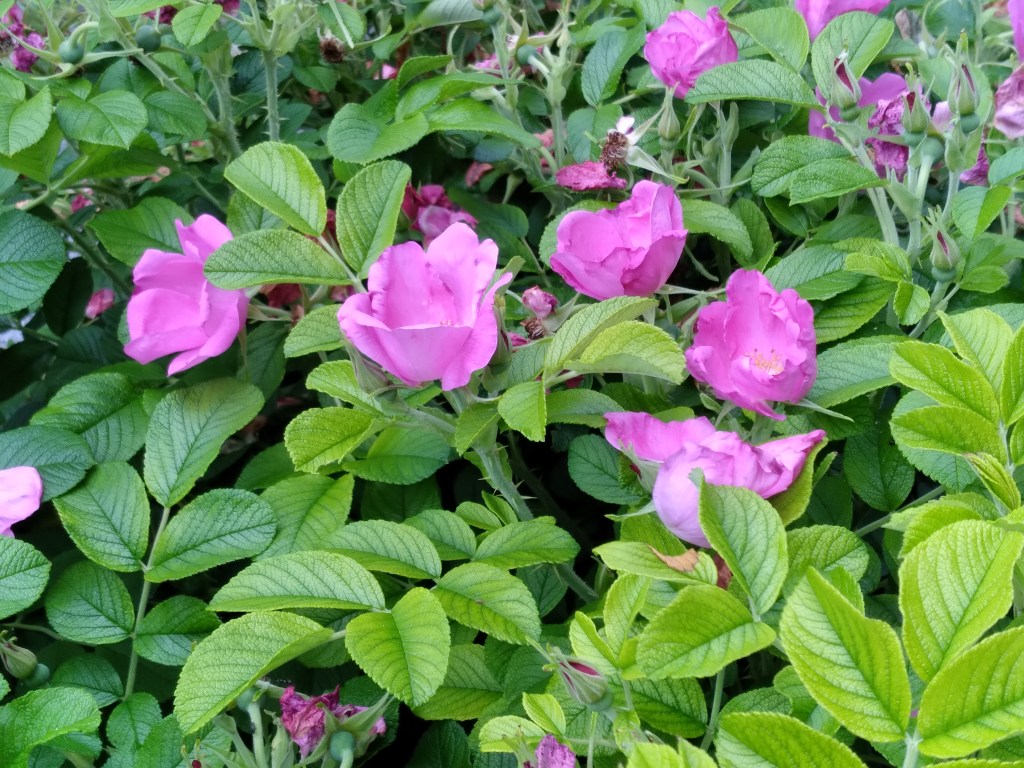
One of the first plants I bought for my garden was a rugosa rose (Rosa rugosa). It’s grown into a beautiful shrub and expanded along the top of the wall in front of my house.
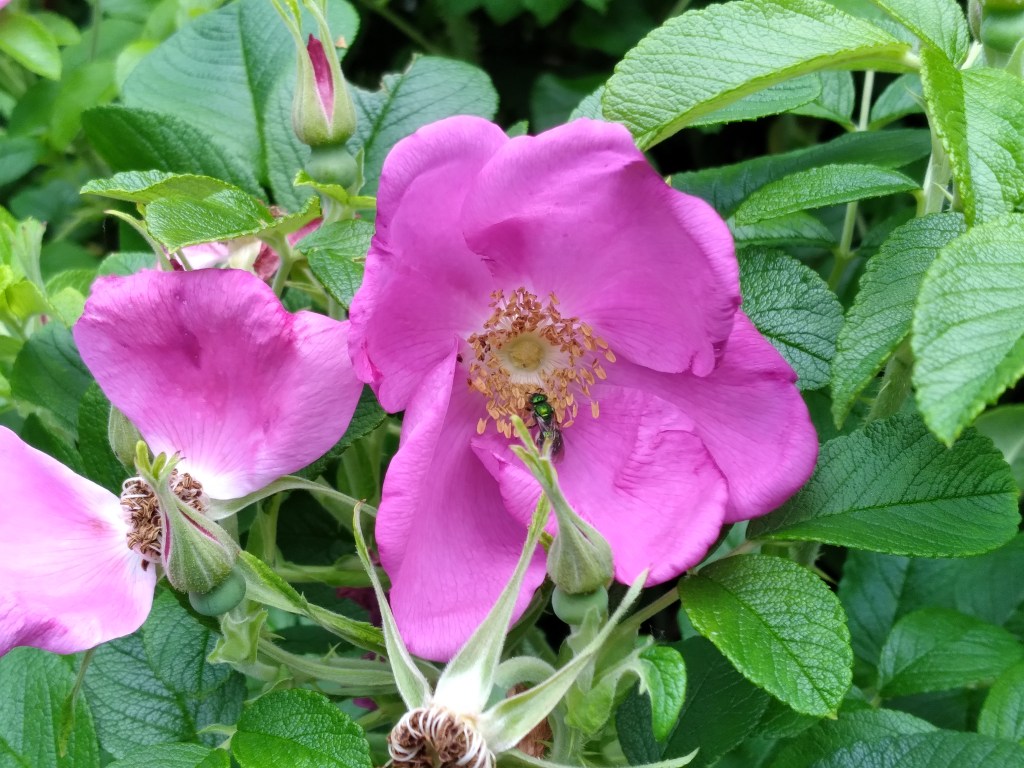
The first thing I learned about rugosa roses was that bees absolutely love them. When the flowers are in bloom (pretty much all season except when the weather is very hot and dry), the hum of visiting bees is audible several feet away. Bumble bees, honeybees, and any number of smaller bees I can’t identify by name all come for a visit. It’s wonderful.
The second thing I learned is that rugosa roses are dangerous. Rather than the larger, singular thorns spaced along the smooth stems of other roses, rugosa roses have a zillion tiny thorns that will not only stab and grab at you but are difficult to find and extract once embedded in fingers and hands. Okay, maybe they don’t have a zillion thorns, but it certainly feels that way. I now don long sleeves and suede gloves when pruning or just working in the area where the rugosa resides. I’ve found a nice piece of sticky tape applied to the skin in the area where the thorn hides is most helpful in removal.
The third thing I’ve discovered about rugosa roses is that they produce very large rosehips. Not only are the bright red baubles very decorative, but they also provide food for birds in the winter. I’ve read a bit about uses for rosehips, and one of these days I’m going to harvest some and try them for myself.
And that brings me to the fourth thing I learned about rugosa roses. They are aggressive. In some areas, they’re considered invasive. They spread by underground runners that will pop up all around the rose with no respect for anything else growing in the area. In the spring, I remove runners and keep an eye out during the growing season. It’s a battle, but it’s teaching me to overcome those guilty feelings at removing a perfectly healthy plant because it’s in the wrong place.
The most recent thing I learned is that rugosa roses are hardy. Not only do they come through our Berkshire winters with little or no damage, this past year they proved just how resilient they are.
In March we had a tremendous storm. It dumped a huge amount of very wet, very heavy snow. Branches of anything with hardwood bent to the ground. Many broke. I was fortunate that the permanent damage around my house was minimal. Most of the trees and shrubs bounced back once the weight of the snow was removed. The rugosa rose was not so fortunate. Many branches broke, including those of an offshoot growing too close to the stairs leading into the house. I’d intended to remove it to prevent injury to visitors, so when I started to clean up the broken branches of the rugosa rose, I cut the one by the stairs to within a few inches of the still frozen ground. I intended to remove the roots in the spring.
Well, spring came and as I worked on other tasks, new growth sprouted from those resilient roots. Before I knew it, buds had appeared. Then flowers. Soft hearted, I couldn’t bring myself to remove the rose. So, it’s still blooming. But at a size where it doesn’t present a threat to passersby. It’s good—for now.
I could remove it any time. Or I could simply cut it back in the fall, so it needs to regrow each spring and hope it remains small and less dangerous. For now, I’ll procrastinate and enjoy the flowers. I’ll pause and take a moment to smell those roses, but from a nice, safe distance.
* * *
Discover more from Pen, Paper, Plant
Subscribe to get the latest posts sent to your email.
 Pen, Paper, Plant
I came here looking for an ID for my rose and I’ve gotten it. Thank you. Mine is white and it’s hardy, so much so that I had cut this one to the quick late last fall. I just noticed that I cannot post a picture, that’s ok, I got an id and I’m reassured that I’m not messing things up(first year tending my mother’s garden for her and I’m paranoid that everything has gotten gall, I’m very neurotic) thank you for the accurate description, I knew this was the right type when you mentioned the rose hips. Thanks again
LikeLike